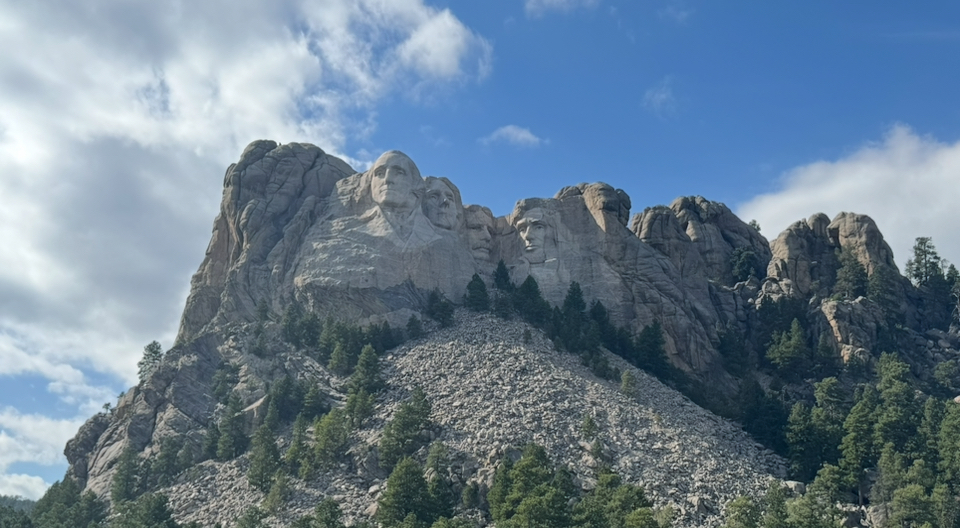
I sit here today looking out over the landscape of South Dakota. The land is inspiring upon first introduce and the people, patient and welcoming. The vista is perfection. The sky perfectly azure with stripes of billowing clouds like a pedestrian crosswalk, the interval equally spaced to hopscotch across the sky. The gold of the prairie grass. The horizon that beckons you onwards to the rising of plateaus carved from something, but what, is unknown. I finally understand the meaning of a ponderosa.
The water glistening with gold flecks. The air somehow cleaner. But then there are the flies. They hover around anyone standing still for more than a few seconds as if at the horses nose. I envision my hair swinging around like a horse’s tail to swat them away. They fly slow and stealthy, then hover near you in a taunt. We decide on a truce, me and the flies. I will keep moving and give them back their space.
I close my eyes and experience days long past. The vibration of stampeding bison causing the ground to rumble. The Indigenious people emerging from their teepees with the speed and accuracy necessary to ensure their people are fed through the harsh winter. The men rushing to grab malots and bows, the youngest in a coming of age tradition of taking down the beast. The women prepping the fires and readying storage and meat racks. The celebration and harvest of every last element of the animal: sinew, bones, fur, meat, innards, heart, all expertly utilized with gratitude.
The Black Hills of South Dakota are the Motherland of the Lakota Tribesmen and women. It is hallowed ground. As you drive from Rapid City airport, a short 45 minutes, the granite presents itself mystifingly. You can feel its beckoning. Jettisoned out of the Earth, it is obvious that it is special. The Lakota felt its spirituality in this location, equally so, it was a clear canvas for an artist.
While we visited Mount Rushmore, it is hard not to imagine the impact such a magnanimous monstrosity must have had on the original utilizers of the land. My heart breaks for them as I inadequately interpret my own relationship with the consequences of such desecration. Yet as an American I marvel at the Presidents and celebrate the feat of its creation.
The two in direct contrast of one another, impossible to reason, a sign of developed societal empathy? How do we judge yesterday with today’s standards. We need to ensure that yesterday’s mistakes are not repeated. We need to learn from our mistakes and do better.
** Special thank you to Matthew for making me think about this, and ensuring that I share the knowledge with my children. There is always another perspective that we are better for having considered.
 MaMaLiRZ
Leave a comment